Monday, February 13, 2012

Pumpkins!

Back in October/November we studied and worked with pumpkins.  (This is one of those catch-up posts!)  Here are a few of the activities that we did during the unit.  We checked out a few books from the library about pumpkins but I forgot to get pictures of them. 

Hammering tacks into a pumpkin.

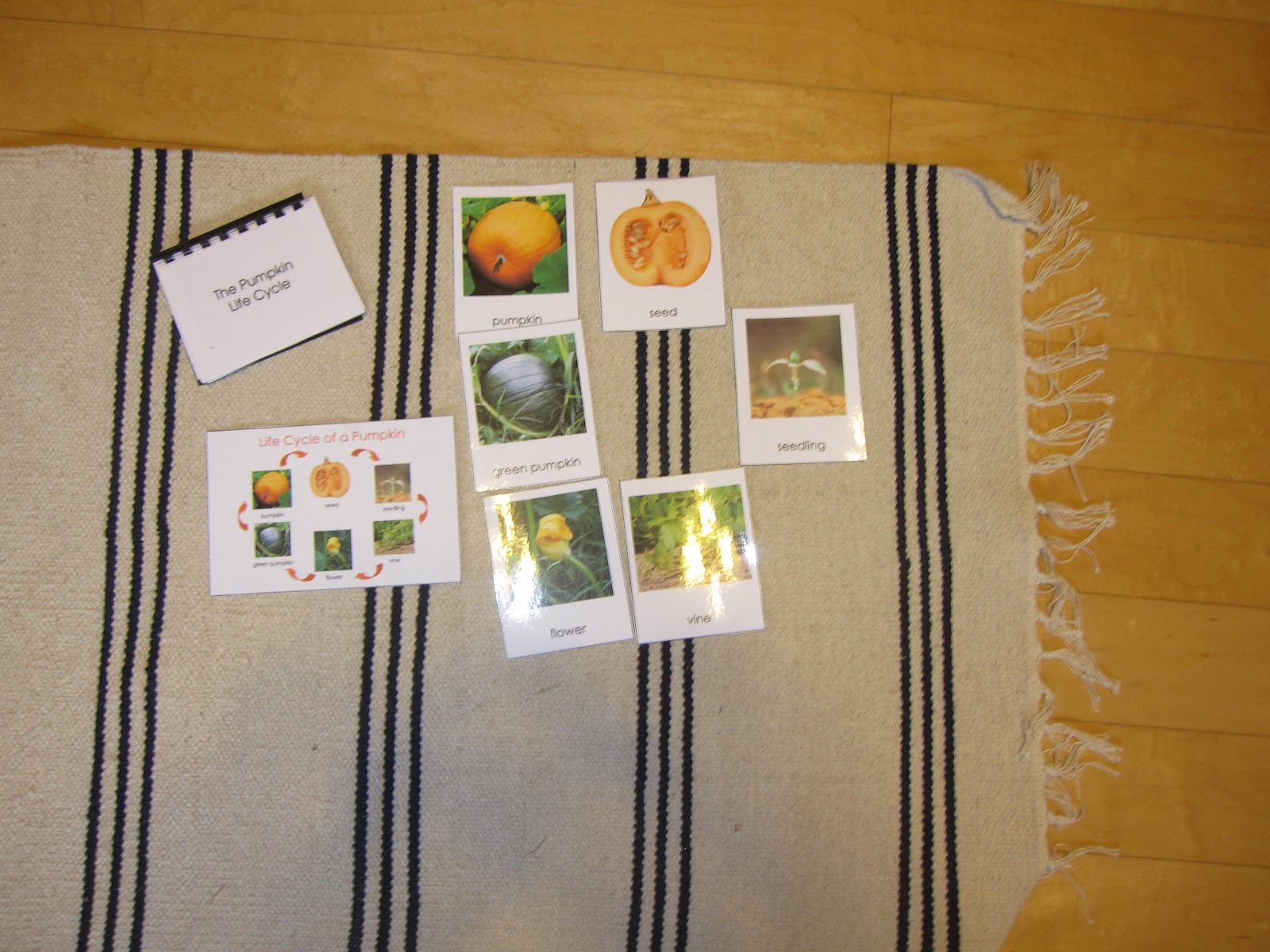
3 part cards for the life cycle of a pumpkin plant
I printed a book about the life cycle of a pumpkin plant and then also the life cycle cards for him to practice setting up the life cycle with the control chart.
Dissecting a pumpkin and learning about its different parts.
Scooping pumpkin seeds for roasting

Bead stair, Teen Beads and Teen Boards

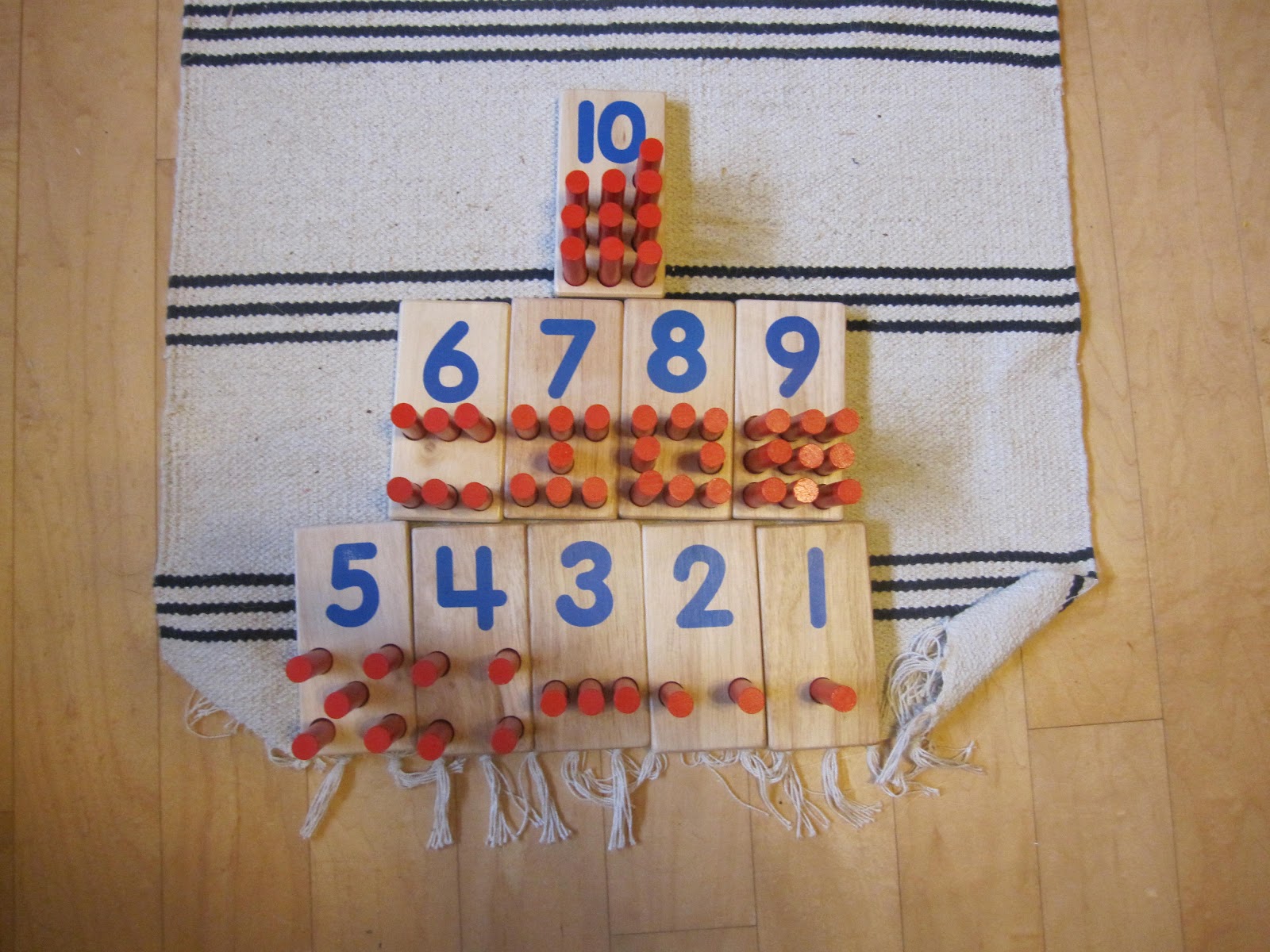
Once Bean had been working on 1-10 and then the concept of zero it was time to move on to the teen numbers.  I introduced him to the Montessori bead stair and he practiced identifying what amount each bead chain was and then putting them in order from 1-9.
Next I introduced the bead chain of 10 golden beads and then we worked on combining one golden bead chain (unit of 10) with each of the above beads to make the numbers 11-19.  We practiced not having to count the gold bead chain as we knew it was already 10 so we could start with 10 and then just continue counting the other colored beads. 


Next I introduced the teen board.  It starts with the number 10 in each space and then you slide a number over the zero to make the teen number.  After demonstrating how it works Bean then was given all the numbers 1-9 and asked to "make 11" or "make 12" and he would have to find the number and slide it into the board to show the number I was asking for. 
Next we combined the teen beads and the teen boards.  He had to both make the number on the board that I asked and then go back and put the correct beads next to it to show the number. 

A bit more math

Using sandpaper numerals to trace with his finger and then practicing writing them on the dry erase board.
Spindle box.  Putting the correct amount of spindles into each compartment.  Introduction to the concept of zero.
Putting the boards in order and then making sure each board had the correct number of pegs.


Reflections on the year so far

Well it's been awhile since my last post.  Luckily, just because the blog hasn't been updated doesn't mean that we haven't been busy with homeschool.  Sure, we've had a few slumps (especially around the holidays and family visiting), but we've been keeping quite busy.  The typical school year is half over at this point so it's a good time to reflect back on our path in this new adventure.  One thing is already decided-we really love homeschooling!  Don't get me wrong.  It's had some challenges but way more rewards.  A few lessons I have learned so far:

1.  Everything is more complicated when trying to do it with an infant.  And I anticipate it only getting worse before it gets better.  Pogo is on the verge of crawling and I have been looking at the classroom trying to get it baby-proofed.  Well, technically not baby-proofed, but at least baby-friendly.  Even my early attempts at rearranging work on the shelves have shown me we are in for some busy months of redirecting baby and cleaning up lots of messes. 

2.  You can plan-but throw expectations out the window.  At the beginning of this journey I tried to sit down and map out what I would like us to be covering during the year in the subjects of geography and science.  It runs a bit counter-intuitive to my like of letting Bean decide what he is interested in but it would be nice to have a framework of topics to help me prepare and request books from the library ahead of time.  That outline?  What a joke!  We've covered some of the areas I planned for but lately I have taken to asking Bean what he wants to study and it has been nice to capitalize on his interests and enthusiasm.

3.  Do what works, not what you thought would work.  When we started this year I was loosely modeling our home classroom on Montessori principles and set-up.  We purchased some Montessori materials (still loving them!) and set up independent work choices on shelves he could reach.  Although that is still our main set-up I have had to change some of the areas.  For instance, although he liked practical life activities I was finding that my efforts in setting up work for the shelves would be enjoyed once, perhaps twice, before it seemed to fall flat.  Perhaps the work was too easy?  Not interesting enough?  After months of changing this area around and continually tweaking it, we took a step back from having a practical life area in the classroom.  He still gets lots of practical life experience in helping around the house but it's an area we have let go of...at least temporarily, since it wasn't working at the time.

4.  Know when to lead and when to follow.  As much as I would like Bean to be a self-starter and choose work from the shelves it doesn't always happen that way.  I mean, the point of having out independent work is for him to choose work independently, right?  But I've noticed that he wasn't making choices in our classroom as he did at co-op.  Maybe it's because it's mom, or being at home, or not specific "school" days.  So sometimes I suggest activities or give him a choice of things to work on.  Again, this goes a bit counter to what I like about Montessori and letting the child lead, but he's receptive to it.  And sometimes it lights a spark for him and then he'll continue onward.  And then there are days when I would like to get a certain lesson done (such as studying shadows for Groundhog's Day) but he has other plans and gets lost in an art project or building project.  I'm learning to let him go on those days, knowing that there is always tomorrow for what I have planned.

5.  Forgive yourself!  We have no schedule of days when we do homeschool or times of the day (outside of mornings being the time that ends up working out best).  That wasn't quite my intention, but it's how it's worked out for the time being.  We are going at a much slower pace in some areas than I thought we would be.  There are many days when we all stay in our pajamas.  We don't get out socially as much as I would like us to.  There are times when Bean has to finish a lesson on his own or wait patiently while I tend to the baby or try to get him down for a nap.  It's not a perfect set-up but we're doing fairly well considering!  I know there's room for improvement and that things will constantly be evolving and I'm ok with that.

The most important part of this is that Bean is learning and loving homeschool.  One of the nice side benefits is how involved Daddy gets to be in homeschool.  Instead of a cursory "How was school today?" at the dinner table, Daddy is actively involved and knows what he's learning.  He gladly shows off his lessons and Daddy has even done a few lessons with him in the evenings and on the weekends.  And some of the best parts of homeschooling are the lessons and games we do as a family.  Another benefit is the bond between the two boys.  We spend all day together.  Sometimes we learn, sometimes we play-but we are always together.  Even though Pogo is only 8 months old I can already see the strong, brotherly bond forming and it's awesome.  If Bean was to spend an hour a day on the bus, seven hours at school, another hour doing homework, I'm not sure they would have the same type of bond.  It almost feels as if homeschooling is actually family schooling as well. 

So outside of wishing I had more time to update this blog I can't say I really have anything I would change about our decision so far.  We love it.  It's working.  And we're committed to homeschooling next year, but being flexible and open about the future.

P.S.  Hopefully there will be a lot of back updating of this blog soon.  We've been busy at work and it's my hope to slowly catch up documenting what we've been doing.  

Monday, November 14, 2011

Number cards and counters

Here Bean is using his number cards and counters (glass beads from Michael's).  After laying out numbers 1-10 in order he had to count out the correct amount of counters for each number.  I helped him lay the first several sets out so that he could see how some numbers have "buddies" or "pairs" while others don't.  This was the precursor to learning about even and odd numbers. 

Sorting objects by initial sounds

In our classroom I have this handy little organizer for our sound objects.  As soon as we decided to homeschool this year I started scouring our house and stores for small objects to use for learning phonics.  We use these when we review a letter sound but also use these when practicing listening for the initial sound in a word. 
Here Bean uses his sandpaper letters and sound objects to sort out by listening for the initial sound in each word.

Apples!

During the month of September we started talking about and studying apples.  Although it's normally a great fall theme on its own around here it takes on a bit more importance as we usually get 2-3 bushels of apples that invade our kitchen for a bit until I can turn them into applesauce that we enjoy throughout the year. Here's a few of the activities and things we did to celebrate the apple harvest season. 
Taste testing different varieties of apples.  It was a unanimous family decision for Jonagolds! 

Studying the life cycle of an apple tree.
3 part language cards for the parts of an apple tree life cycle.
Collection of apple books we had in our bookshelf.
Dissecting an apple and learning about the different parts.  Labelled picture downloaded from http://montessoritidbits.blogspot.com/2010/10/parts-of-apple.html
Labeling his own picture of the parts of an apple.  Again, picture from Montessori Tidbits (see link above). 
Probably Bean's favorite project-shrunken apple heads!  He made his into a vampire pirate.

Tissue paper art.

Bean's drawing of an apple.

Bean's new apple corer/slicer.  This was used for not only snack time but helping mom prepare apples for the crockpot during applesauce making time.

Downloaded book from Enchanted Learning.  Lots of neat little activities and coloring pages to extend the theme.

One of the pages from his book.  Identifying an apple tree during the four seasons. 

Tuesday, November 1, 2011

El Dia de los Muertos-Remembering Corey

November 1st is El Dia de los Muertos or The Day of the Dead.  It is a holiday to remember, honor and celebrate our loved ones who have passed on.  I think this is such a wonderful holiday and our family has started to incorporate it into our traditions.  Families typically visit the cemetery where the loved one is buried and bring a picnic dinner of their favorite foods, sing songs that the loved one enjoyed, share stories about them, light candles and sometimes spend the night in the cemetery.
 Here are two of the books we read tonight.  Of course the Rookie Reader for the holiday which always does such a wonderful job of explaining things so simply and clearly.  The top book "I Remember Abuelito" was a really wonderful story of a little girl and her family celebrating El Dia de los Muertos by remembering her grandfather.  It showed the many traditions they had in honoring their loved one who passed away, including sprinkling marigold petals on a path to the house so their spirit can come visit, which I would love to incorporate in future years.

This year we remembered my brother Corey who died last January at the age of 20 in a car accident.  I had kept a candle from his service and we lit that tonight to show how our love for him still shines even though he isn't here.  We looked at pictures and shared memories.  Bean remembered our last trip to Florida, mere months before Corey died, when they played Legos together.  My husband remembered how Corey was the only one who could get kisses from our old dog Sophie.  I shared lots of memories from when he was much younger before I was married or had kids.  Then we enjoyed some of Corey's favorite foods from when he was little-deviled eggs, butter bread and olives.  He could sure pack away his favorite foods when he was younger and tonight Bean would have made him proud.  He enthusiastically ate each of them, had second helpings and declared that he loved all the same foods as Uncle Corey.  What a wonderful walk down memory lane and the reason I really have grown to love this holiday.

On our shelves for Halloween

I try to make sure that we have several choices for interesting independent work on the classroom shelves for Bean to choose.  In anticipation of Halloween I had been hoarding fun, little activities I had picked up from Michael's, Target and the Dollar Store as well as things from my old teaching stash.  Here's what he has been enjoying in the two weeks leading up to Halloween.


Halloween tree with costumed Smores men ornaments.  Great for practicing balancing since the tree will tip if they are not evenly spaced out.
Some of the books we had out for Halloween.  The one in front I made from a download from Montessori Print Shop.

Halloween cutting strips.  After he would cut them into strips we would cut them out individually and use them for art or patterning work.

Making Halloween cards.  Foam shapes and letters to use for decorating.

Lacing Halloween rings (spiders, skulls, bats).  He wasn't much into the lacing but perhaps we can use these next year for sorting by type or color.

Halloween playdough.  Always a hit when I put out seasonal cookie cutters and seasonal colored playdough.

Make a Jack o' Lantern face.  Kind of like a Wooly Willy but for Halloween!

Making a Halloween necklace.  Last month I had out pony beads and he made tons of bracelets and necklaces with them.  When I found this little pack of beads for $1 I knew it would be his thing.
Decorate a foam pumpkin with plastic face shapes.  I was hoping he would do this several times but he made one face, declared it done and perfect and had no interest in doing it again.  Oh well, they can't all be winners.

Fun with Color!

For the past several weeks we have been playing around with color.  We've used all sorts of materials to see how different colors are made.  Here's a few of the activities and experiments we have done. 


On our work shelves I set out this color mixing activity.  Bean had 3 eye droppers and bottles with the 3 primary colors (watered down red, yellow and blue food coloring) in them and 4 small glass bowls for mixing colors.  Initially he was given the freedom to explore his own color combinations.  After we had done more talking about making secondary colors from primary colors I pulled this work off of the shelves and we used it to make secondary colors together.  But honestly most of the time he would take delight in mixing all of the colors together to make a dark greenish-brown concoction he would call "coffee".  At least at those times he was practicing fine motor control with the eye droppers, right?  :)


We have a couple of sets of these great color paddles.  We hung one set in the big window of the classroom so that we could enjoy the "rainbow" it would make as the afternoon sun shined through the window.  We also used the other set to play around with mixing colors.  We would put the red and yellow paddles together to see how it would be orange where they overlapped.  We did that for blue/yellow and red/blue as well. 

 For his birthday Bean had gotten a prism and now was the perfect time to bring it out again after we read the Rookie Reader "All the Colors of the Rainbow".  We used it inside and outside to find rainbows that it would make. 


Here are a couple of our favorite books we read about mixing colors.  Bean loved "Mouse Paint" since the mice jumped in the paint and stirred it with their feet.  I really loved "Color Dance" and would recommend it to anyone doing a color unit.  Dancers mix colors by twirling their colored scarves together as they dance.  It also talks about how white makes color more pale and gray makes colors darker.  Just a beautifully illustrated book overall.


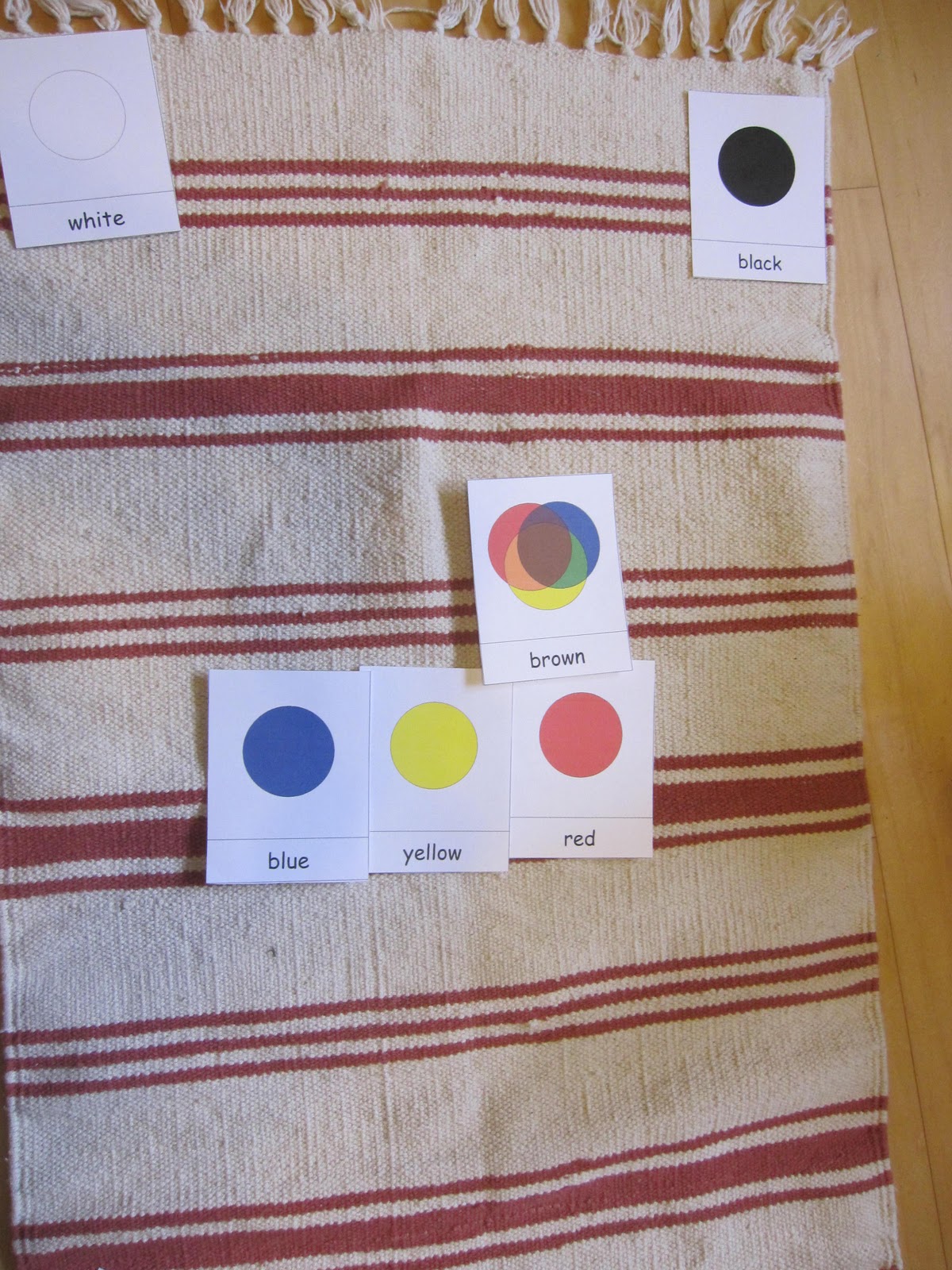
I got a copy of these color 3 part cards from a friend.  I didn't make them into traditional 3 part cards.  Instead we used them to show how colors mix together.  At the top of the mat, I would put all of the single color cards.  In the middle I would lay down a mixed color card and ask Bean to find the two (or more) colors that make up the mixed color.  After all of our earlier lessons he breezed through this.

 We also watched as color danced and mixed in a cup.  We started with a glass of water and put a thin layer of oil on the top.  Then we would put a small drop of food coloring on the oil layer and wait patiently for it to drop down into the water where it would mix.  As we added different colors they would mix together to in the water to make new colors.  The most fun part is watching the color as it explodes in the water after making its way through the layer of oil.  Kind of like a lava lamp!


We also tried mixing color in milk when a drop of dish soap is added.  We had done lots of experimenting with colors and water and would see how they would mix to make new colors.  This activity was a bit different.  We started with a dish of milk and put one drop of each primary color of food coloring spaced out evenly around the edge.  Then we added a few drops of dish soap in the middle and then tried to bring the colors together to mix.  However the dish soap would keep the colors (mostly) apart and we ended up with a cool tie dye effect!